How to Say You Are Not Funny in French How to Say Hello in Italian
The Intrepid Guide contains affiliate links. These commissions help reduce the ever-increasing costs of keeping this site active. Thanks for reading!
It all starts by learning how to say 'Hello' in Italian. Break the ice and put a smile on locals faces with few common Italian greetings and you'll be adopted into la famiglia (the family) in no time!
You know what they say, you never get a second chance to make a first impression. One guaranteed way to avoid being treated like a tourist and enjoy authentic travel experiences in Italy is by greeting locals in their native language. The best part? Italian greetings are super easy to learn too!
Knowing just a few words in Italian can make a huge difference. It's respectful and shows that you're making an effort to learn more about the people who speak the language, their beautiful country and culture.
When locals hear foreigners greet them in their language, they instantly become warmer and friendlier towards you.
Italians are some of the most generous, kindest, and most talkative people in the world. They literally make you feel like one of the family. Imagine how wonderful your travels in Italy would be if you did as little as just greeted Italians in Italian and asked them how they are doing!
During one trip to Sicily, me and my four international girlfriends went out to dinner the first night. Shortly after we arrived at the restaurant, the lady at the table next to use took an interest in us and started talking to us. Maria was so impressed that we could all speak Italian, that she invited all us over to her home the next day for afternoon tea! This was the result of a brief five minute conversation! It just goes to show that a little can go a long way. Anything is possible! Read all about how mastering Italian changed my travel experiences and how it can help you do the same!
Can you handle the warmth and friendliness headed your way?
If so, read on! Here are some of the most common Italian greetings, as well as useful expressions you can use to ask Italian how they are doing and how to say goodbye.
Cominciamo! (Let's get started!)
Looking for something specific? Use these links to jump around.
Table of Contents
-
- Formal vs. Informal: How to be Polite in Italian
- Italian Greetings: 10 Common Ways to Say 'Hello' in Italian
- Tips for using Italian Greetings
- 16 Ways to Say 'Goodbye' in Italian
- Tips for saying 'Goodbye' in Italian
- Gesti Italiani: How Italians say 'Hello' and 'Goodbye' with gesti (gestures)
- 5 Ways to Ask 'How are you?' in Italian
- 10 Common Ways to Reply to 'How are you?' in Italian
Formal and Informal: How to be Polite in Italian
In Italian, it's important to know that there is a formal and an informal way to address another person. Unlike in English, our version of being formal and informal is the difference between not swearing or just using more sophisticated words.
Italian has an informal tense which is used when speaking with good friends, young people, children, and your family members. Basically, anyone you know well.
However, when speaking to a person you don't know well such as a superior, shopkeeper, waiter, teacher, professor, or someone of important social standing such as a doctor, or police officer, then you should address him or her in the formal tense.
When you become more familiar with someone, you may change from using the formal tense to the informal tense. According to custom, the elder person initiates this change.It's handy to learn both tenses even if you don't use the informal very much. Whenever in doubt, the safe option is to use the formal tense.
Italian Greetings: 10 Common Ways Italians Say 'Hello'
1. How to say 'Hi' in Italian – Ciao!
How to pronounce it: chaow
Meaning: Hi, Bye
Usage: Informal Italian greeting
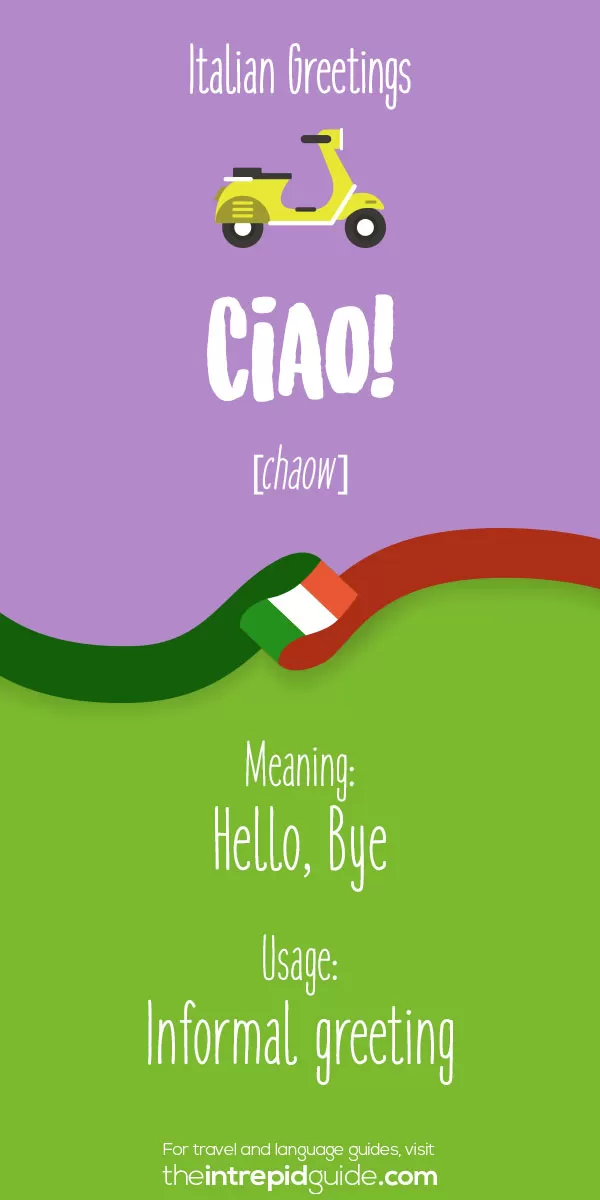
When you are meeting some friends, for instance, be it morning or evening, you can say 'ciao' both when you meet and when you say goodbye. Since 'ciao' is an informal greeting you only use it in conversations with friends or family or people you know very well. Avoid using it with people of high social importance such as police officers, doctors, your boss or a teacher.
The origins of 'ciao' are rather interesting too with its roots in the Venetian dialect. The original phrase was 'scia'o vostro' which literally meant 'I am your slave'. This phrase was typically used to say 'I am there if you need me'. Similar to the English 'at your service', it was an expression or promise of goodwill among friends.
Nowadays, 'ciao' is one of the most popular greetings not only in Italy but in the whole world. Languages around the world have adopted 'ciao' as one of the ways to say hello and/or goodbye. In Germany, for example, it can be spelled 'ciao' or 'tschau', in French it's 'tchao' in Czech it's spelled 'čau', in Greek it's 'τσάο' and in Spanish it's 'chau'. And that's just to name a few!
However, if you don't want to repeat the same word all the time or need something more formal, here's a formal Italian greeting you can use.
Depending on how you say 'ciao' it can also take on a new meaning. For example, in Italian and Portuguese, when you say it twice, either 'ciao ciao!' or 'tchau tchau!' it means 'goodbye', but when you say it three or four times, it means "bye, I'm in a hurry!".
When an Italian is super happy to see you, they will drag out the pronunciation of the 'a', which is them basically saying "Hi! I'm so happy/amazed to meet you!"
Want to be sarcastic? Italian's might say something like 'sì, ciao!', meaning 'Yeah, right!'.
2. How to say 'Hello' in Italian – Salve
How to pronounce it: sal-veh
Meaning: Hello, Bye
Usage: Informal and formal Italian greeting
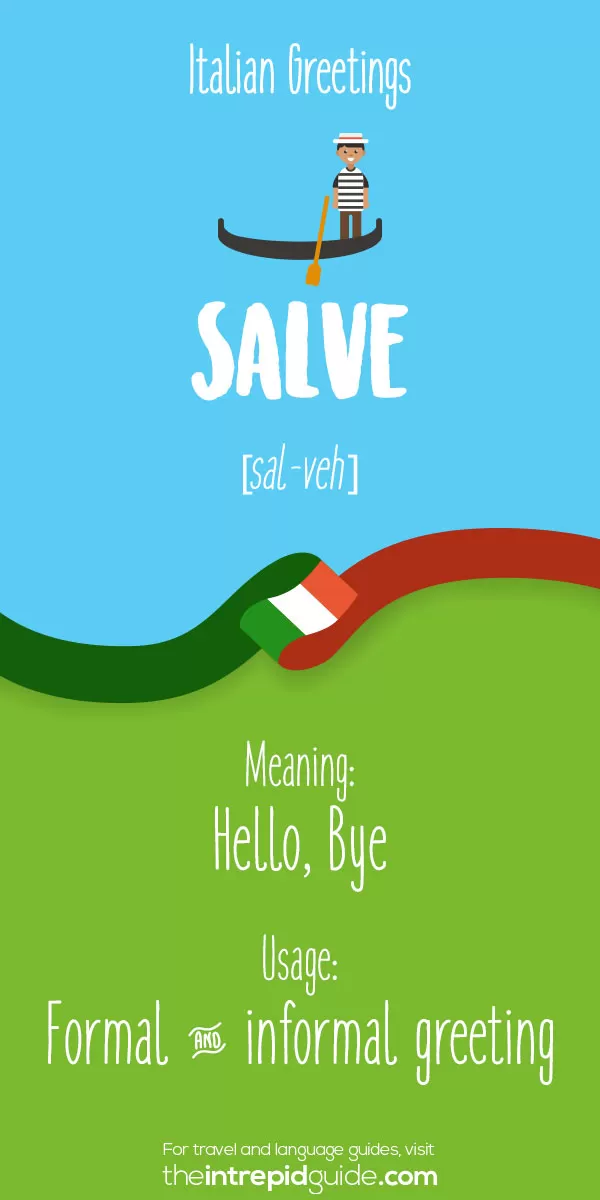
The word 'salve' comes from the Latin verb 'salvere', which means 'to be well, in good health', related to 'salvus', 'health'. The English words 'to salute' and 'salutations' have similar roots.
You can use 'salve' if you want to 'salute' someone in a formal or informal situation at any time of the day.
3. How to say 'How nice to see you' in Italian – Che piacere (ri)vederti
How to pronounce it: keh pyah-chair-ray (ree)veh-der-tee
Meaning: How nice to see you (again)
Usage: Informal Italian greeting

If you want your greeting to be a little more enthusiastic and emotional, tell the person that it is a pleasure to see them. 'Piacere' means 'pleasure'. In fact, these two words originated from the same Latin root.
Use this greeting when they want to tell someone how happy they are to see them (vederti) or see them again (riverderti).
Italians tend to use this expression when they haven't seen someone in a while or with someone they see often but are genuinely happy to see them again.
4. How to say 'Good Morning' in Italian – Buongiorno
How to pronounce it: bwohn-jor-noh
Meaning: Good morning
Usage: Informal and formal greeting used before 3-4 p.m

'Buongiorno' literally means 'good day' and it is used to say 'good morning' and 'good afternoon' in Italian. You can safely use it up until around 3-4 o'clock in the afternoon.
'Buongiorno' is a formal alternative to 'ciao' (but until 4 p.m.) and it is a good polite phrase to use whenever greeting a stranger or in a public place, like a shop or a cafe.
5. How to say 'Good Afternoon / Good Evening' in Italian – Buonasera
How to pronounce it: bwoh-nah-seh-rah
Meaning: Good afternoon/ Good evening
Usage: Informal and formal greeting used after 3-4 p.m
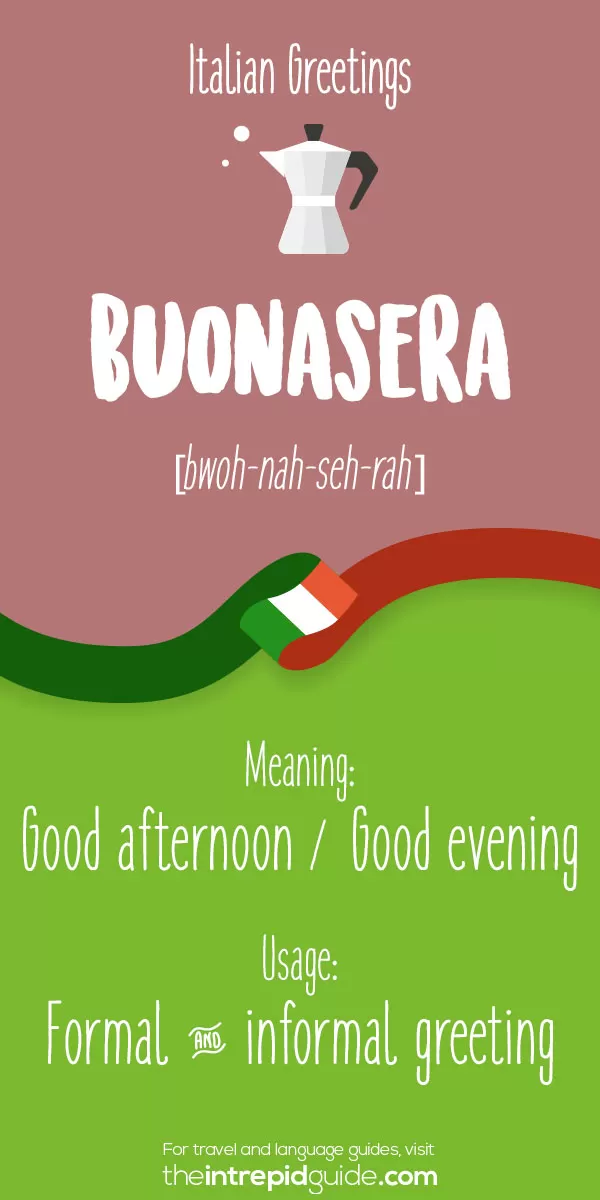
It is okay to say 'buonasera' up until as late as 10 p.m., in formal and informal situations. People use it with friends, but it is slightly more polite than 'ciao' and, like 'buongiorno', it is a polite phrase to use when you enter a shop or another public place where you're likely to encounter people you don't know..
When you are leaving and want to wish someone a good evening, you can say 'buona serata'.
6. How to say 'Hey' in Roman – Aó!
How to pronounce it: aaow
Meaning: Hey! Hi! / Wow!
Usage: Informal Roman dialect greeting
When in Rome, do as the Romans do….use Roman greetings! If you want to sound Roman and impress your newfound Roman friends, then say 'Aó!'. This is a very informal greeting and not really used anywhere else in Italy as it's from the Roman dialect Romanesco. Get more cool Roman dialect words and expressions here.

This common Roman greeting is very common among friends and you'll often hear them say something like 'Aó! Ciao! Come te butta?' meaning 'Oh Hey! Hi, how's it going?'. (Come te butta? literally means 'How are you throwing yourself'. I just love the imagery!
'Aó' is also used as an exclamation to mean something 'wow' and is added either to the beginning or end of a sentence for emphasis.
Recommended: Top 10 unsual things to do in Rome that aren't on your list
7. Say 'Buon dì' as an alternative to 'Buongiorno'
How to pronounce it: bwohn dee
Meaning: Hello, Good morning
Usage: Informal and formal Italian greeting

Buon dì greeting is less used than 'buongiorno' but will add variety to your speech and impress your Italian friends. They will, naturally, be glad to just hear 'ciao' or 'buongiorno' from you, but 'Buon dì, come va?' (Good morning, how's it going?) might win you a few more points.
8. How to say 'Nice to meet you' in informal Italian – Piacere di conoscerti
How to pronounce it: pyah-chair-ray dee koh-noh-sher-tee
Meaning: Nice to meet you
Usage: Informal Italian greeting

It is quite common for the following exchange to happen when two Italians meet for the first time: Piacere. — Piacere (Nice to meet you. — Nice to meet you, too.). Another possible reply is 'altrettanto'.
9. How to say 'Nice to meet you' in formal Italian – Piacere di conoscerLa
How to pronounce it: pyah-chair-ray dee koh-noh-sher-lah
Meaning: Nice to meet you
Usage: Formal Italian greeting

'Piacere di conoscerLa' is a formal way of saying 'nice to meet you' to someone you would also use the form pronoun 'Lei' with.
10. How to say 'Hello' on the phone in Italian – Pronto!
How to pronounce it: pron-toh
Meaning: Hello! (lit. ready)
Usage: Neutral Italian greeting
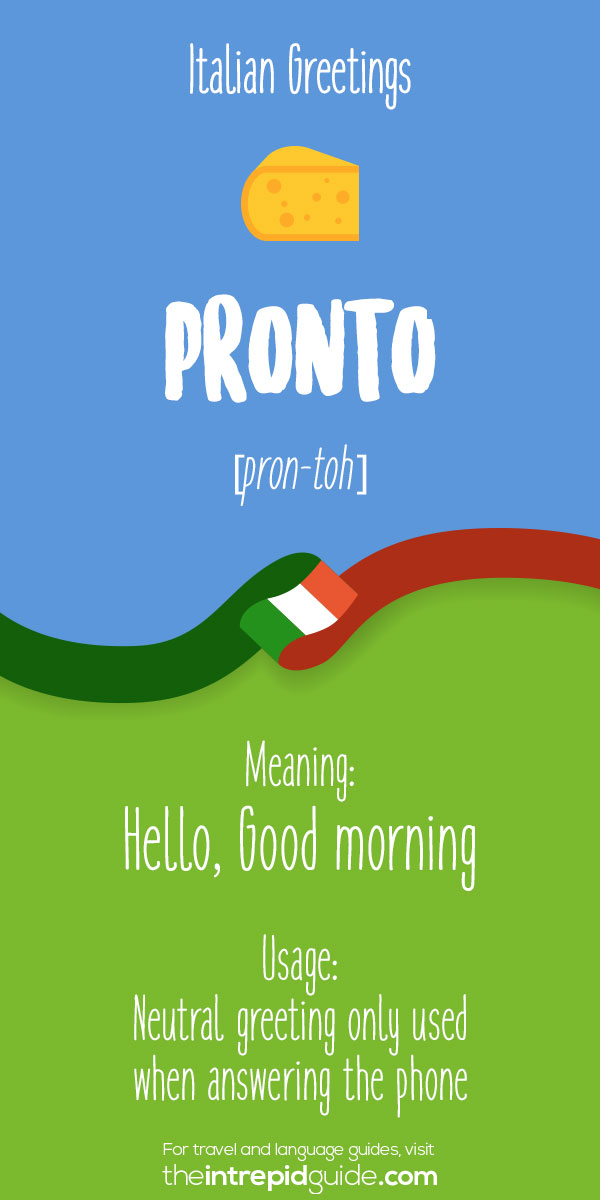
Next time, when your Italian teacher or your friends from Italy call you, greet them with a 'Pronto!' – they will be glad to hear it!
Tips for using Italian Greetings
When greeting someone, Italians often use a combination of all the greetings shown above. For example, in Rome you might hear: 'Aó! Ciao! Come stai!', or 'Salve, Buongiorno!', or 'Salve! Che piacere vederti!'
There are as many ways to say 'goodbye' in Italian as there are Italian greetings. Read on to find out how to correctly bid an Italian 'goodbye'.
16 Ways to Say 'Goodbye' in Italian
1. How to say 'Bye!' in informal Italian – Ciao!
How to pronounce it: chaow
Meaning: Hi, Bye
Usage: Informal Italian greeting
When you are leaving a group of people, mix things up by saying 'Ciao a tutti!' (Bye, everyone!) or 'Ciao ragazzi! (Bye guys/gals!)
2. How to say 'Bye!' in formal Italian – Salve!
Meaning: Bye
Usage: Informal and formal Italian greeting
'Salve' as a goodbye functions the same as 'salve' as a greeting: it is totally fine to use it with friends, but it is also okay in a formal setting. That is why it is one of the best options to go for if you are not quite sure how formal the situation is or if you don't know someone well.
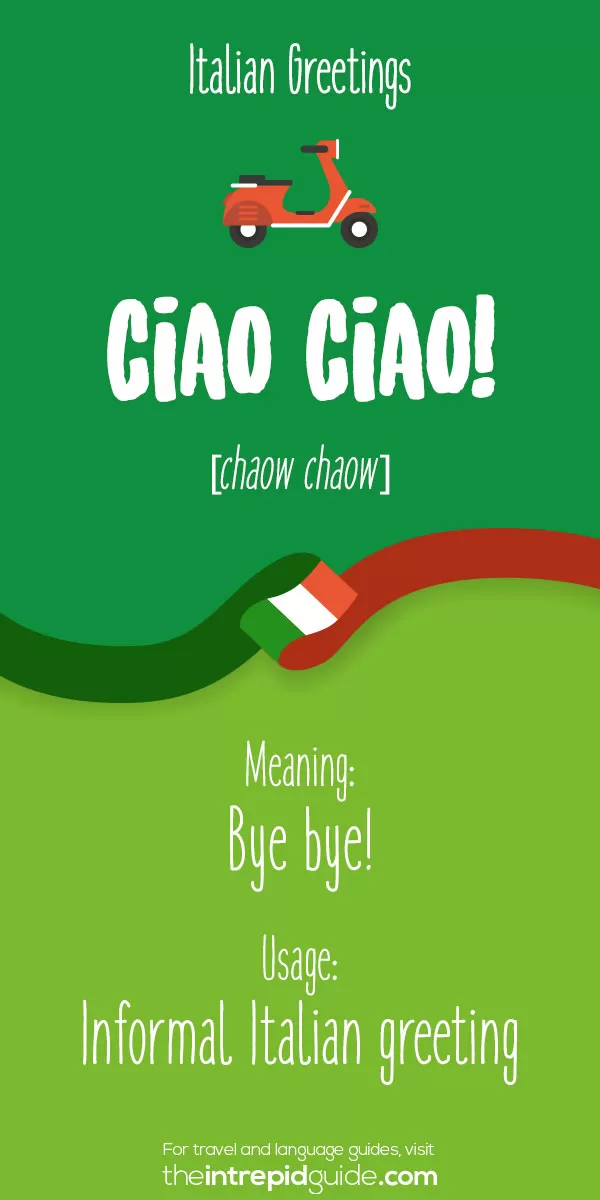
3. How to say 'Bye bye!' in Italian – Ciao! Ciao!
How to pronounce it: chaow chaow
Meaning: Bye bye!
Usage: Informal Italian greeting
4. How to say 'Have a good day' in Italian – Buona giornata
How to pronounce it: bwoh-nah jor-nah-tah
Meaning: Have a good day
Usage: Informal and formal Italian greeting used before 3-4 p.m

'Buongiorno' or 'buona giornata' can be used to wish someone a good day as you leave. You can say 'buona giornata' anytime up until around 3 or 4 o'clock in the afternoon.
What do you say after 4 p.m.? That's what we're looking at next!
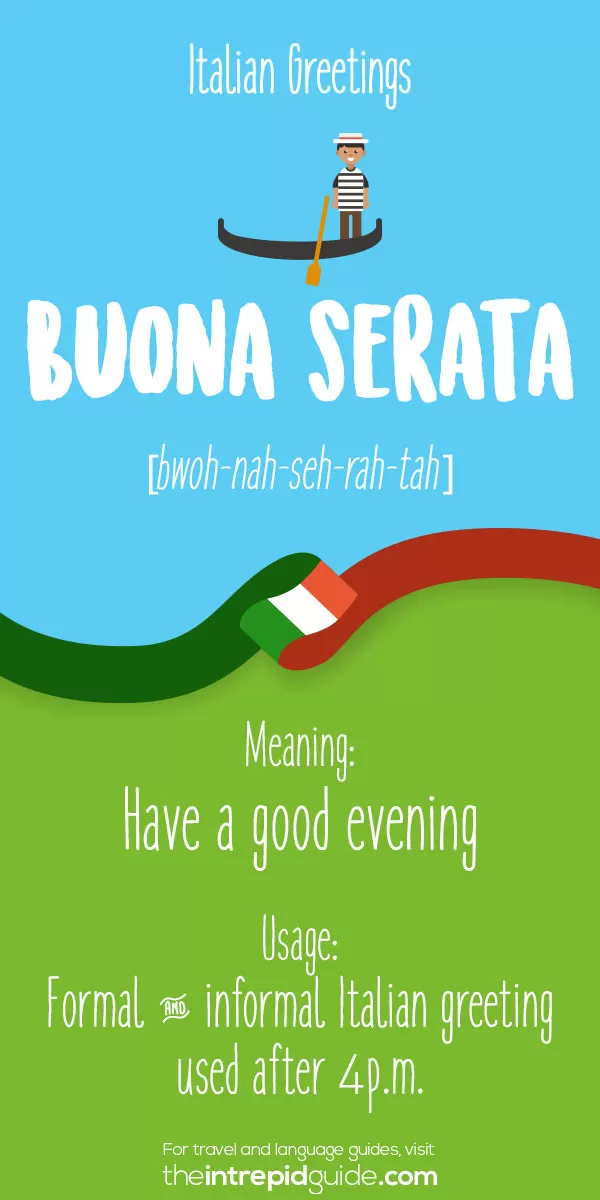
5. How to say 'Have a good evening' in Italian – Buona serata
How to pronounce it: bwoh-nah-seh-rah-tah
Meaning: Have a good evening
Usage: Informal and formal Italian greeting used after 4 p.m
6. How to say 'Godspeed' in Italian – Buon proseguimento
How to pronounce it: bwohn pro-seh-gwee-men-toh
Meaning: Enjoy the rest of your day/evening, Godspeed
Usage: Informal and formal Italian greeting, anytime of day

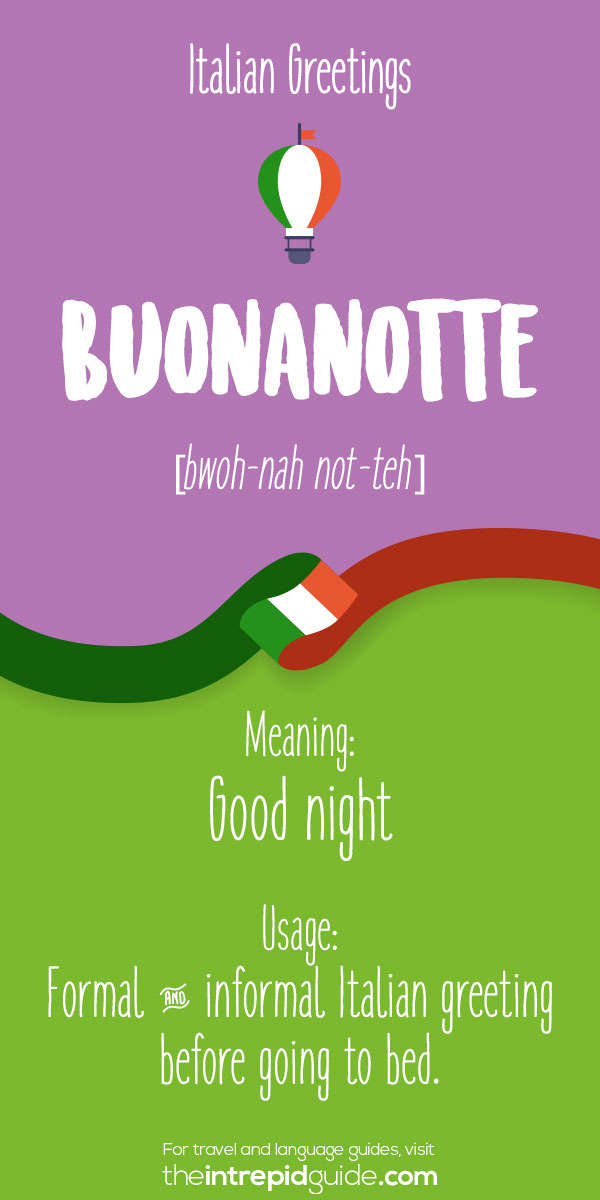
7. How to say 'Goodnight' in Italian – Buonanotte
How to pronounce it: bwoh-nah not-teh
Meaning: Good night
Usage: Informal and formal Italian greeting, when leaving to go home or to bed
If you're out with friends and leave earlier than that others, it is better to say 'buona serata' or 'buon proseguimento', as you're wishing for them an enjoyable (rest of the) evening.
8. How to say 'Goodbye' in Informal Italian – Arrivederci
How to pronounce it: ar-ree-ve-der-chee
Meaning: Goodbye
Usage: Informal Italian greeting

9. How to say 'Goodbye' in Formal Italian – ArrivederLa
How to pronounce it: ar-ree-ve-der-lah
Meaning: Goodbye
Usage: Formal Italian greeting

You use 'arrivederLa' when you are speaking to one person, the 'ci' in 'arrivederci', is the plural version. If you speak to an elderly person, it's a good idea to use 'arrivederLa' – it won't sound pompous or pretentious, it will only highlight your respect.
Of course, situations may differ. You can be super-informal with your grandma or on friendly terms with all the big bosses at work. However, when dealing with a foreign culture, it is best to be a bit on the formal side at first before you get to know the people and the culture better.
10. How to say 'See you later' in Italian – A dopo
How to pronounce it: ah doh-poh
Meaning: See you later (literally, until later)
Usage: Informal Italian greeting

Imagine seeing a foreign guest off at the airport and they say 'see you soon'. It is not that big of a mistake, but it feels weird as you are unlikely to see them again soon or maybe at all.
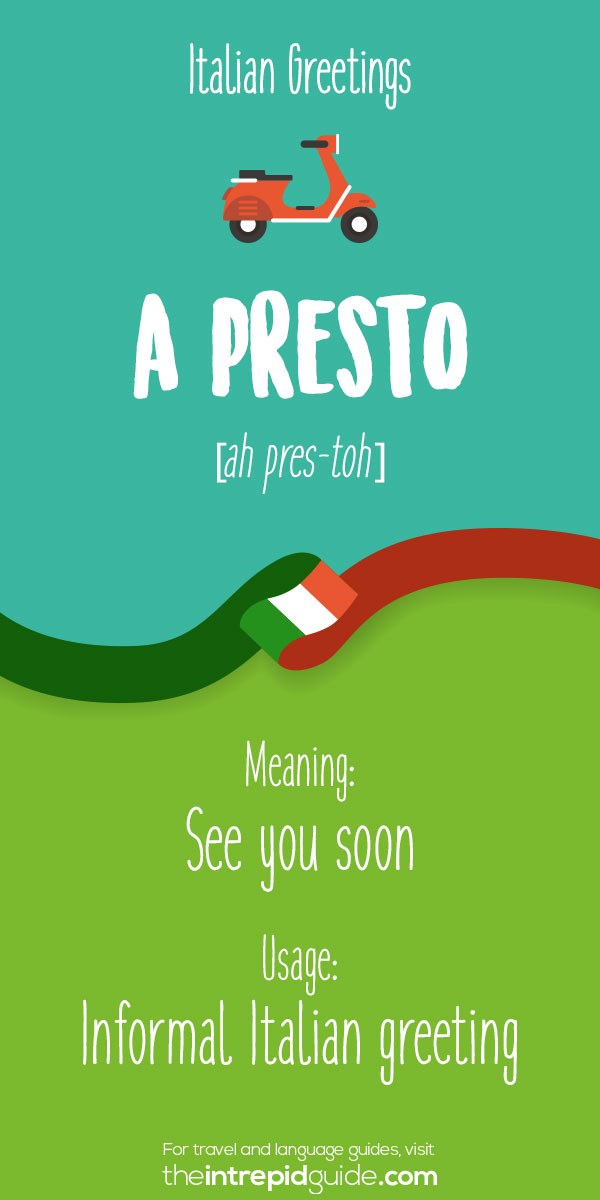
11. How to say 'See you soon' in Italian – A presto
How to pronounce it: ah pres-toh
Meaning: See you soon (literally, until soon)
Usage: Informal Italian greeting
If you are leaving work for the day and saying goodbye to your colleagues who you will see the next day – great. If you have been traveling in Italy and are leaving to go back to your home country – this is not the best choice. Instead, saying 'arrivederci' would be more appropriate.
12. How to say 'See you tomorrow' in Italian – A domani
How to pronounce it: ah doh-mah-nee
Meaning: See you tomorrow (literally, until tomorrow)
Usage: Informal Italian greeting

13. How to say 'See you in a bit' in Italian – A tra poco / A fra poco
How to pronounce it: ah tra poh koh / ah fra poh-koh
Meaning: See you in a bit (literally, until a little)
Usage: Informal Italian greeting

14. How to say 'See you' in Italian – Ci vediamo
How to pronounce it: chee ved-yah-moh
Meaning: See you (literally, until we see each other)
Usage: Informal Italian greeting

15. How to say 'Bye' in informal Italian – Ti saluto! Vi saluto!
How to pronounce it: tee sah-loo-toh / vi sah-loo-toh
Meaning: See you, bye (literally, I salute you)
Usage: Informal Italian greeting

Use this fun Italian salutation as you leave by saying something like, 'Ora torno a casa, ragazzi, vi saluto!' – I'm going home now, guys. Bye!
Just the word 'saluto' is also commonly used to end written correspondence to friends and family. For example, 'Grazie Mario, un saluto a te e famiglia' – Thanks Marco, greetings to you and the family.
16. How to say 'Take Care' in Italian – Stammi bene / Statemi bene
How to pronounce it: stahm-me beh-nay / stah-teh-me beh-nay
Meaning: Take care (literally, stay well)
Usage: Informal Italian greeting

Tips for saying 'Goodbye' in Italian
Similar to Italian greetings, Italians often use a combination of several different expressions when saying goodbye. For example, 'Ciao ciao! Ci vediamo' or 'Ciao! A dopo!', 'Buona giornata! ArrivederLa'.
Gesti Italiani: How Italians say 'hello' and 'goodbye' with gesti (gestures)
Italians are an animated bunch and love using their hands or gesti (gestures) to express themselves. Body language plays a big part when Italian greet each other and say goodbye.
Kissing on the cheek is big in Italy. This is reserved for close friends and family and between men (although maybe a tad less common). To avoid an embarrassing accidental kiss on the cheek, the rule to rule is to kiss the left cheek first and then the right.
If you're on less familiar terms, the first time you meet someone, a traditional handshake is common. Once you get to know the person, you'll no doubt move into cheek-kissing territory. Pucker up!
From a simple bacio sulla guancia (a kiss on the cheek) or un abbraccio (a hug), match your Italian greeting with these common gestures:
- Informal: A kiss on each cheek, and/or a hug with friends and relatives.
- Formal: Shake hands with new acquaintances and in formal situations
5 Ways to ask 'How are you?' in Italian
1. Come sta? – How are you?
How to pronounce it: koh-meh stah
Meaning: How are you?
Usage: Formal Italian greeting

2. Come stai? – How are you?
How to pronounce it: koh-meh staiee
Meaning: How are you?
Usage: Informal Italian greeting

3. Come va? – How's it going?
How to pronounce it: koh-meh vah
Meaning: How's it going?
Usage: Informal Italian greeting

4. Come vanno le cose? – How are things (going)?
How to pronounce it: koh-meh vahn-noh leh koh-zeh
Meaning: How are things (going)?
Usage: Informal Italian greeting

5. Come te butta? – How are ya?
How to pronounce it: koh-meh vahn-noh leh koh-zeh
Meaning: How are ya? (literally, How are you throwing yourself?)
Usage: Informal Roman dialect greeting

10 Common Ways to Reply to 'How are you?' in Italian
1. Sto bene! – I'm well!
How to pronounce it: stoh beh-nay
Meaning: I'm well
Usage: Formal/informal greeeting

2. Molto bene, grazie – Very well, thanks
How to pronounce it: mol-toh beh-nay, grat-zyeh
Meaning: Very well, thanks
Usage: Formal/informal greeeting

3. Abbastanza bene, grazie – Quite well, thanks
How to pronounce it: ab-bah-stahn-za beh-nay, grat-zyeh
Meaning: Quite well, thanks
Usage: Formal/informal greeeting

4. Non c'è male – Not bad
How to pronounce it: nohn cheh mah-lay
Meaning: Not bad
Usage: Formal/informal greeeting

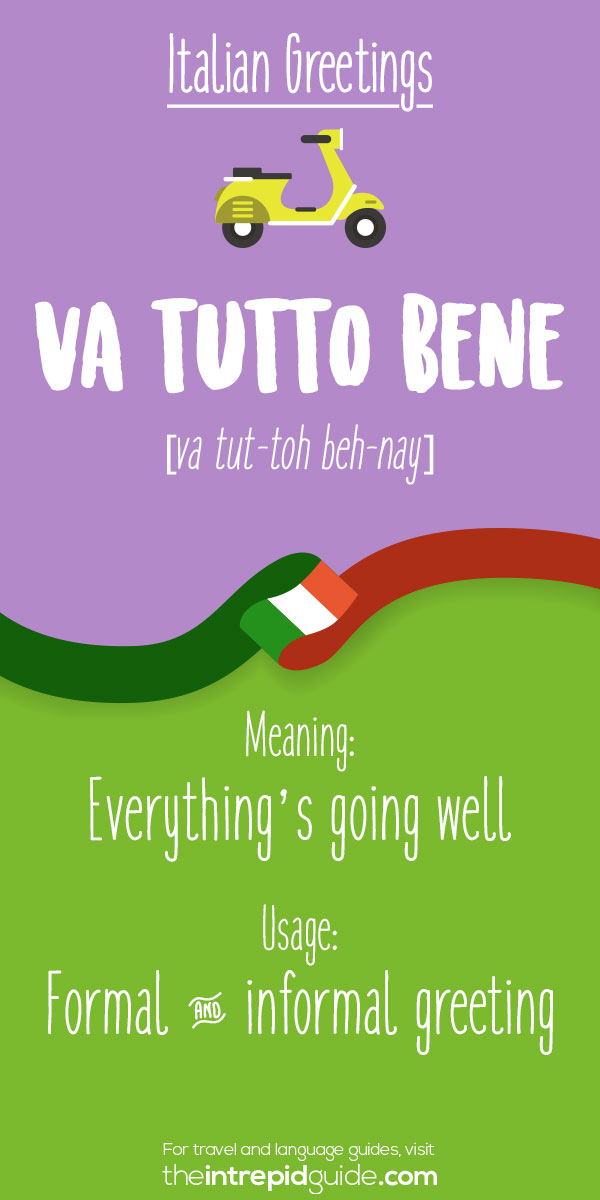
5. Va tutto bene – Everything's going well
How to pronounce it: va tut-toh beh-nay
Meaning: Everything's going well
Usage: Formal/informal greeeting
6. Benissimo! – Great!
How to pronounce it: ben-ees-see-moh
Meaning: Great! / Very well!
Usage: Formal/informal greeeting

7. Va benissimo! – Things are going great!
How to pronounce it: va ben-ees-see-moh
Meaning: t
Usage: Formal/informal greeeting

8. Così così – So-so
How to pronounce it: koh-zee koh-zee
Meaning: So-so
Usage: Formal/informal greeeting

9. Non mi posso lamentare – I can't complain
How to pronounce it: nohn mee pos-soh lah-mehn-tah-ray
Meaning: I can't complain
Usage: Formal/informal greeeting

10. Alla grande! – Awesome!
How to pronounce it: al-lah grahn-day
Meaning: Great! / Amazing!
Usage: Informal, Roman dialect

An equally Roman and positive response to the Roman 'Come te butta?', Alla grande! means 'Awesome!', literally – "in a big way".
C'è la puoi fare! (You've got this!)
That's it! You've just learned the most common Italian greeting. There is a lot to choose from and may seem overwhelming at first, but as you put them into practice hear them being used, you'll realise they are easier to learn than you think.
Quite often you can use the same phrases to both greet and say goodbye to someone so if at first you struggle to remember which greetings are formal or informal, just remember one or two: 'buongiorno' (Good morning) and 'arrivederci' (Goodbye).
The important thing is to stay motivated and have a positive attitude. Learning Italian greeting are a great way to get your foot in the door and break the ice with locals, even if your fumble and make mistakes. Any effort you make will always be appreciated. If you accidentally slip and say 'ciao!', Italians are very forgiving people and can see that you're still learning.
As the saying goes, well begun is half done. Learning Italian greetings is a great start to mastering the Italian language for travel and making a good first impression on your future new Italian friends.
Learn Italian FAST! Enrol in my popular Italian course here.
Learn Italian with me, The Intrepid Guide!
Travelling to Italy? Don't be treated like a tourist! Live your best travel experiences and learn Italian for less than the cost of eating at a tourist trap restaurant or a taxi driver who has "taken you for a ride". In addition to my free Italian travel phrase guides, I've made it even easier for you to master the Italian language so you can create lifelong memories as you mingle with locals, get local tips, avoid tourist traps, and make new friends. Who knows you, you maybe even be invited over for afternoon tea by a lovely Sicilian family, like I was! Read all about how speaking Italian changed my life and check out The Intrepid Guide Languages courses here.
Here's what my students are saying:

I really enjoyed the Master Italian for Travel FAST course, it certainly exceeded my expectations. The learning methodology is great, and easy to follow and found that I progressed much faster in the last 4 weeks than I ever did on my own or using other language apps. Grazie mille Michele, I can't wait until I can put my new skills into action! – Roma Small
Click here for instant access!
Learning Italian? Check out these Italian language guides
- How to Conjugate Italian Verbs in 3 Simple Steps [Italian for Beginners]
- 10 Ways Natives REALLY Say 'You're Welcome' in Italian
- 125 Most Common Italian Phrases for Travel You'll Ever Need [PLUS Printable]
- Is Italian Hard to Learn? 7 Common Mistakes & How to Avoid Them
- Master Days of the Week in Italian (7 Simple Memory Hacks)
- Italian Numbers: How to Count in Italian From 0 to 1 Billion (Plus PDF Download)
- How to Order Food & Drinks in Italian [Italian for Beginners]
- 15 Italian Words You Should NEVER Mispronounce [& How Not To]
- 11 Effective Hacks That'll Help You Learn Italian So Much Faster
- Top 14 Italian Words You Should NEVER Say [& What to Use Instead]
- 20 Hilarious Everyday Italian Expressions You Should Use
- Romanesco: 25 Cool Roman Dialect Words You Should Use in Rome
- 10 Reasons Why Learning Italian Will Change Your Life
- 10 Italian Expressions Italians Love Saying
- Italian for Beginners | 8 DEADLY Mistakes in Italian (& How to Avoid Them)
- 10 Italian Phrases That Will Instantly Make You Sound more Italian
- Funny Italian Sayings: 26 Food-Related Insults You Won't Forget
- 15 Romantic Italian Films That'll Make You Love Italy Even More
- How to Master Common Italian Phrases for Travel (Like a Local!)
Want to know more about learning languages? Start here!
- 22 Top Language Learning Resources You Should Use
- 10 Proven Memory Hacks: How to Remember New Vocabulary Faster
- How long does it REALLY take to learn a language? [A Practical Guide]
- 10 Proven Memory Hacks: How to Remember New Vocabulary Faster
- 18 Unexpected Advantages & Health Benefits of Learning A Foreign Language
- 23 Cool Gift for Language Learners They Will Actually Use and Love
- Memrise vs Duolingo: Which Language App is Best For You?
- Mondly Review: 10 Ways Mondly Drastically Improved My Language Learning
- 203 Most Beautiful Untranslatable Words [The Ultimate List: A-Z]
- 6 Language Learning Tips: How to Learn a Language from Home
- What Type of Language Learner Are You? Your 4-Step Personalised Learning Plan
- 44 Best Movies on Disney Plus for Learning Languages
- 13 Ways to Seamlessly Integrate Language Learning into Your Daily Life
- 10 Pro Tips: How to Learn a Language with a Full-Time Job
- 7 Reasons Why You Should Go on a Language Holiday
- Essential Travel Phrases: How to be Travel Fluent in 10 Simple Steps
- How to Learn Your First Foreign Language in 8 Simple Steps: A Beginner's Guide
- 11 Life-Changing Reasons Why You Should Learn a Language
- 42 beautiful Inspirational Quotes for Language Learners
- Language learning tips: 11 Polyglots Reveal The Secrets of Their Success
- Top 10 Best Ways to Learn a Language Better and Faster
- How Many Languages are there in the World?
- 78 FREE Dictionaries to Learn a Language Fast [Free eBook Download]
- 22 KEY Travel Phrases That Will Transform Your Travels [Free Guide]
Like it? Pin it for later!

Over to you!
Do you have a question these Italian greetings or learning Italian? Ask me below!
Let me know using the comments section below or join me on social media to start a conversation.
Thanks for reading and I hope you enjoyed this post.
Like what you see? Subscribe using the form below to have all of my posts delivered directly to your email.
Source: https://www.theintrepidguide.com/italian-greetings-how-to-say-hello-in-italian/
0 Response to "How to Say You Are Not Funny in French How to Say Hello in Italian"
Post a Comment